
The Market Decides — Not You
April 16, 2026
🇴🇲 In Oman, Business Is Not Driven by Time—It’s Driven by Trust
April 23, 2026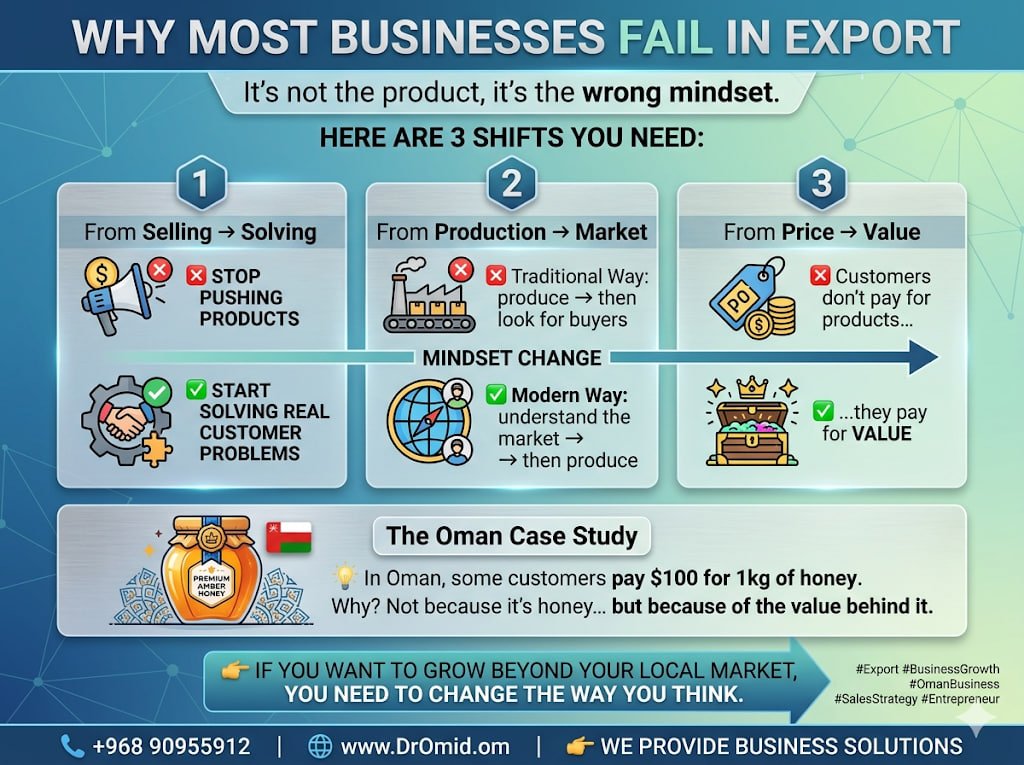
Expanding into international markets is often seen as a natural next step for growing businesses. Yet, many companies fail in export—not because of weak products or limited resources—but because of fundamental flaws in their thinking.
Export success is not just operational. It is deeply strategic and mindset-driven.
Before entering global markets, businesses must undergo three critical shifts:
1. From Selling → Solving
Most companies approach export with a sales mindset:
“How can we sell our product in another country?”
This is the wrong starting point.
Modern markets are saturated with products. Customers are not looking for more options—they are looking for solutions to their problems.
A product becomes valuable only when it addresses a real need.
Strategic Implication:
- Stop focusing on pushing products
- Start identifying unmet needs in target markets
- Design your offering around problem-solving
Companies that sell compete on price.
Companies that solve problems compete on value, trust, and relevance.
2. From Production-Driven → Market-Driven
Traditionally, businesses follow this model:
Produce first → then search for a market
This approach significantly increases risk, especially in international markets where:
- Customer preferences differ
- Regulations are stricter
- Competition is more intense
Modern export strategy reverses this logic:
Understand the market → identify demand → then produce
Strategic Implication:
- Conduct deep market research before production
- Analyze customer behavior, expectations, and gaps
- Align product design with actual demand
Export is not about finding customers for your product.
It is about creating the right product for the right market.
3. From Price → Value
One of the most common misconceptions in export is:
“To compete internationally, we must lower our price.”
In reality, global markets reward perceived value, not just affordability.
Customers are willing to pay premium prices when they:
- Trust the brand
- Recognize differentiation
- Perceive higher value
A Real Market Insight from Oman:
There are customers who pay up to $100 per kilogram for honey.
Why?
Not because honey is rare.
But because the product is positioned with clear value, trust, and differentiation.
Strategic Implication:
- Shift your focus from cost to value creation
- Invest in branding, positioning, and customer experience
- Communicate benefits, not just features
🎯 Export Is a Positioning Strategy
Export is often misunderstood as a logistics or distribution challenge.
In reality, it is a market positioning decision.
If your business:
- Competes primarily on price
- Lacks clear differentiation
- Starts with production instead of demand
Then entering international markets will only scale your existing weaknesses.
💡 Final Thought
Before asking:
“How can we export our product?”
Ask:
“What problem are we uniquely solving in that market?”
This single shift in thinking can define the difference between failure and sustainable global success.
📞 +968 90955912
🌐 www.DrOmid.om
👉 We Provide Business Solutions