
PESTEL Analysis for Export: How to Evaluate a Market Before You Export
April 28, 2026
Free Seminar on Branding and Sales for Beauty Salons
May 4, 2026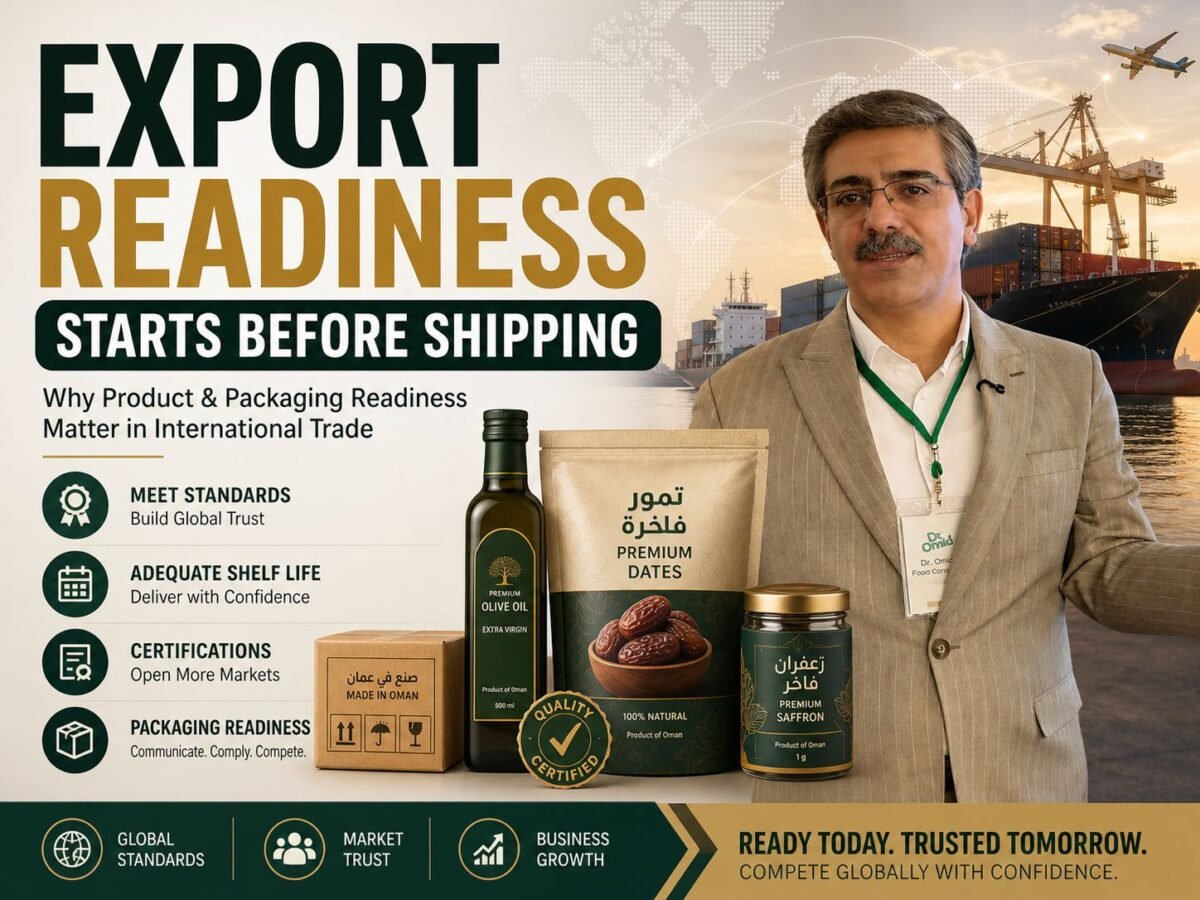
Many businesses assume that export begins when a product is manufactured and ready to be shipped.
In reality, export begins much earlier.
A product does not become export-ready simply because it has been produced, packed, and placed in a warehouse. Export readiness begins before shipping — at the stage where a business evaluates whether its product is truly prepared to enter and compete in an international market.
This is where many businesses make costly mistakes.
They focus on production, but overlook readiness.
They focus on supply, but ignore presentation.
They focus on quality, but forget compliance.
And in export markets, these gaps are often the difference between acceptance and rejection.
What Does Product Readiness Really Mean?
Product readiness means more than having a functional or high-quality product.
It means the product is commercially, technically, and strategically prepared for international trade.
A product may perform well in its local market and still fail in export because international markets do not evaluate products only by utility. They evaluate them by standards, compliance, trust, and presentation.
In practical terms, product readiness means asking a much more important question than “Is the product good?”
The real question is:
Is the product ready to be accepted in another market?
That question changes everything.
Because in export, quality alone is not enough.
The product must also be understandable, compliant, credible, and easy to trust.
The Core Elements of Product Readiness
Before a product can enter a foreign market, it must satisfy several essential conditions.
1. Compliance with International Standards
A product must meet the standards expected in its target market.
This may include technical specifications, safety requirements, manufacturing consistency, ingredient restrictions, performance expectations, or documentation requirements depending on the product category.
A good product that fails to meet market standards is not export-ready.
International buyers do not buy based only on product quality.
They buy based on confidence that the product meets expected standards and can be sold safely in their market.
This is why compliance is not an administrative detail.
It is a market entry requirement.
2. Adequate Shelf Life
Shelf life is one of the most overlooked factors in export readiness.
A product may be excellent in quality, but if it does not have enough remaining shelf life for shipping, customs clearance, storage, distribution, and retail display, it becomes commercially weak.
For many categories — especially food, cosmetics, supplements, and chemicals — shelf life is not just a technical issue. It directly affects marketability.
A distributor does not want to receive a product that has already consumed a large part of its usable life before reaching the shelf.
“Shelf life adequate” is not a minor technical phrase.
It is a commercial signal.
It tells the buyer that the product has enough remaining usable life to move through the market with confidence.
3. Certifications and Documentation
Certifications are not just formalities.
They are trust mechanisms.
In international trade, certifications reduce uncertainty and increase buyer confidence.
Depending on the product and market, buyers may expect quality certifications, origin documents, inspection reports, health certificates, compliance declarations, or industry-specific approvals.
Without these, even a strong product can become difficult to trust.
In export, buyers do not only evaluate the product.
They evaluate the system behind the product.
Certifications signal that the product is supported by process, control, and accountability.
4. Consistency in Production
A product is not export-ready if quality changes from one batch to another.
International trade depends on consistency.
A buyer who receives one strong shipment and one weak shipment will not treat that as a small issue. They will treat it as unreliability.
Consistency in production means maintaining the same quality, specifications, performance, and standards in every unit and every batch produced.
This is one of the most important foundations of long-term export relationships.
Export success is rarely built on one good shipment.
It is built on repeatability.
Why Packaging Readiness Matters More Than Most Businesses Think
Many businesses treat packaging as a final design task.
In export, packaging is not decoration.
It is strategy.
Packaging is often the first point of contact between the product and the buyer. Before the product is touched, tested, or consumed, it is judged by its packaging.
That means packaging performs multiple roles at once:
- It protects the product
- It communicates information
- It builds trust
- It signals quality
- It supports compliance
- It influences purchase decisions
In export markets, packaging is not just a visual layer.
It is part of the product itself.
Packaging Is Communication
Export packaging must communicate clearly with the target market.
That means the packaging should not only look attractive — it must also be understandable.
A strong export package should communicate:
- What the product is
- What it contains
- How it should be used
- Where it was made
- Whether it complies
- Why it can be trusted
If the packaging fails to communicate these clearly, the product creates friction before it creates interest.
And in international markets, friction reduces trust.
Language Readiness: English and Arabic Matter
One of the most common export packaging mistakes in regional trade is language failure.
A product may be excellent, but if the packaging does not speak the customer’s language, trust drops immediately.
For many regional markets, especially across the GCC, packaging should be prepared in both English and Arabic.
This is not just a translation issue.
It is a market readiness issue.
Language on packaging must be:
- Clear
- Accurate
- Professional
- Legible
- Market-appropriate
Poor translation, unclear wording, missing Arabic, or awkward English can make even a good product appear weak or unreliable.
In export, language is part of perceived quality.
Label Compliance Is Not Optional
A label is not just a design element.
It is a compliance tool.
Export labels often need to meet specific legal and commercial requirements depending on the destination market. This may include:
- Product name
- Ingredients or composition
- Country of origin
- Manufacturing and expiry dates
- Storage instructions
- Batch number
- Net weight
- Barcode
- Importer details
- Certification marks
Missing, unclear, or non-compliant labeling can delay customs, weaken distributor confidence, or block market entry entirely.
This is why label readiness is one of the most important parts of packaging readiness.
Attractive Packaging Builds Commercial Trust
Attractive packaging is not only about beauty.
It is about credibility.
A well-designed package communicates professionalism, quality, and confidence. It helps the buyer believe the product belongs in a serious market.
Poor packaging does the opposite.
Even when the product inside is strong, weak packaging lowers perceived value.
In export, buyers often judge product quality before using the product — simply by how it looks on the shelf.
This is why attractive packaging is not cosmetic.
It is commercial.
Export Readiness Is a Market Decision
Many businesses define readiness internally.
But export readiness is not decided by the producer.
It is decided by the market.
The real test is not whether the manufacturer believes the product is ready.
The real test is whether the market accepts it as ready.
That decision is shaped by standards, shelf life, compliance, packaging, language, labeling, and trust.
Export success begins long before logistics.
It begins when the product is ready to be accepted.
That is where real export readiness starts.