🇴🇲 In Oman, Business Is Not Driven by Time—It’s Driven by Trust
April 23, 2026
PESTEL Analysis for Export: How to Evaluate a Market Before You Export
April 28, 2026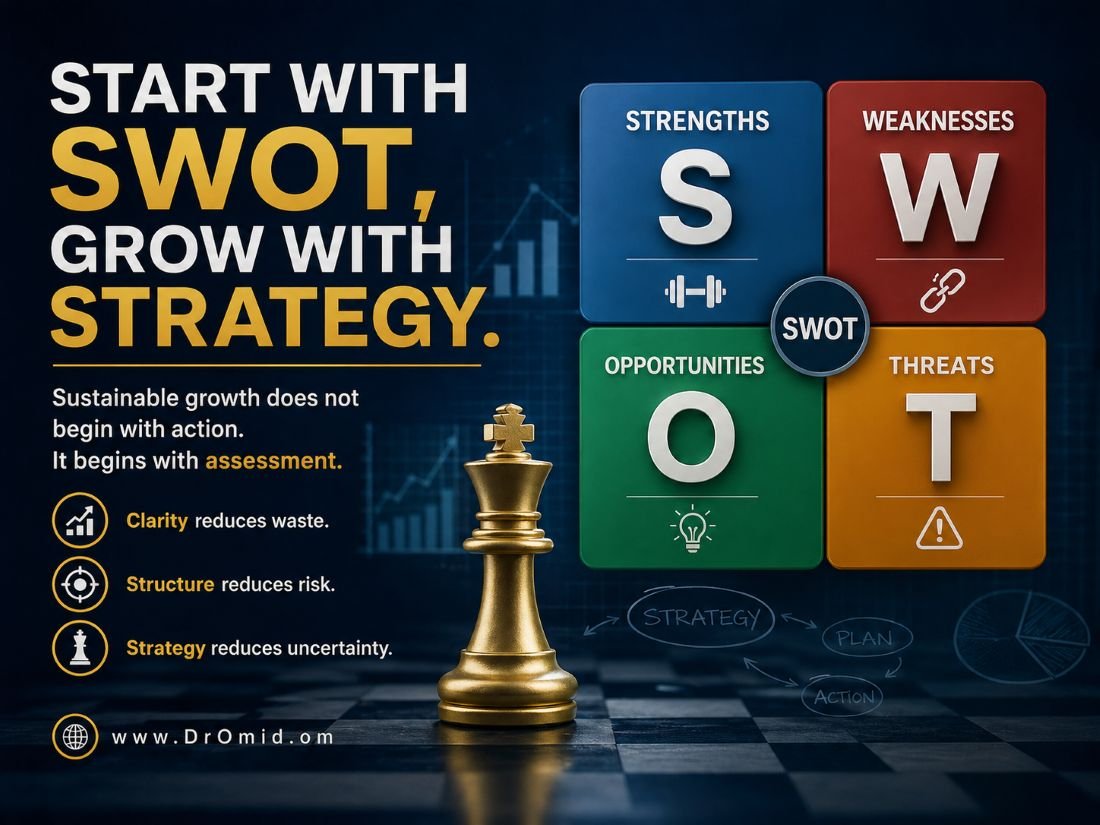
Why Sustainable Business Growth Begins with Assessment, Not Action
In business, growth is often treated as the ultimate objective. More sales, more marketing, more customers, more expansion. For many organizations, growth becomes the default answer to every challenge. If revenue slows down, increase marketing. If sales decline, expand outreach. If competitors become more visible, invest in promotion.
But in practice, growth without clarity often creates more problems than progress.
Many businesses do not fail because they avoid growth. They fail because they pursue growth too early, too quickly, and without a clear understanding of their own internal realities or external environment.
Sustainable growth does not begin with action. It begins with assessment.
Before increasing sales budgets, launching new campaigns, entering new markets, or expanding operations, business leaders need to understand one critical reality: growth is only effective when the business is structurally prepared for it.
This is why SWOT analysis remains one of the most practical and strategically valuable tools in business.
Why Businesses Rush Into Growth Too Early
One of the most common strategic mistakes in business is assuming that growth is simply a matter of doing more.
More advertising.
More hiring.
More sales activity.
More products.
More market exposure.
On the surface, this seems logical. Growth appears to be the natural result of increased effort and investment.
But growth does not solve structural weakness. It amplifies it.
If a business has unclear positioning, growth amplifies confusion.
If a business has weak internal systems, growth amplifies inefficiency.
If a business lacks customer understanding, growth amplifies waste.
If a business has operational gaps, growth amplifies instability.
This is why many businesses experience expansion without real progress. Revenue may increase temporarily, but inefficiencies, customer dissatisfaction, internal pressure, and strategic inconsistency increase with it.
Growth without structure creates pressure.
Growth with structure creates scale.
The difference between the two begins with strategic assessment.
Why SWOT Still Matters
Despite the emergence of more advanced strategic frameworks, SWOT analysis remains one of the most practical tools for business assessment because it forces organizations to evaluate both internal reality and external conditions before making growth decisions.
SWOT stands for:
- Strengths
- Weaknesses
- Opportunities
- Threats
Its value lies in its simplicity. SWOT creates strategic clarity by helping decision-makers understand where the business stands today before deciding where it should go next.
It provides a structured view of four essential dimensions:
- What gives the business an advantage
- What limits performance and growth
- Where the market is creating opportunity
- What external risks may challenge sustainability
This simple framework helps transform assumptions into strategic insight.
And in business, clarity is often more valuable than speed.
Strengths: Identify What Creates Advantage
Every business has strengths, but many organizations fail to identify them accurately.
Strength is not simply what a business does well. It is what creates meaningful advantage in the market.
This may include:
- Strong customer relationships
- Brand trust and reputation
- Efficient internal systems
- Market experience
- Technical expertise
- Loyal clients
- Fast delivery
- High service quality
- Unique positioning
The purpose of identifying strengths is not self-praise. It is strategic leverage.
Businesses grow faster when they understand what already works and deliberately build on it.
Without clarity on strengths, companies often underuse their greatest assets.
Weaknesses: Identify What Slows Growth
Weaknesses are often more important than strengths because weaknesses define the limits of scale.
A business can have strong products, strong branding, and strong demand — and still fail because of internal weaknesses.
These may include:
- Poor follow-up systems
- Weak customer retention
- Inefficient operations
- Lack of internal accountability
- Inconsistent service quality
- Poor sales structure
- Weak financial visibility
- Limited management systems
- Unclear communication between teams
Weaknesses are not simply operational flaws. They are growth constraints.
The purpose of identifying weaknesses is not criticism. It is prevention.
Businesses that ignore weaknesses often confuse temporary momentum with long-term growth.
Opportunities: Identify Where the Market Is Opening
Growth becomes sustainable when it aligns with real market opportunity.
Opportunities are not assumptions. They are observable openings in the market that a business is positioned to capture.
These may include:
- Changing customer behavior
- New demand patterns
- Competitor gaps
- Emerging industries
- Underserved customer segments
- Regulatory shifts
- Digital transformation
- Pricing gaps
- Partnership opportunities
The purpose of identifying opportunities is to direct growth toward market relevance.
Many businesses grow in the wrong direction simply because they expand based on internal ambition rather than external opportunity.
Opportunity should shape expansion. Not ego.
Threats: Identify What Can Disrupt Progress
Every growth strategy is vulnerable to external pressure.
Threats are not pessimism. They are strategic realism.
These may include:
- Stronger competitors
- Price pressure
- Changing regulations
- Economic instability
- Shifts in customer expectations
- New market entrants
- Supply chain disruption
- Technology disruption
- Political uncertainty
The purpose of identifying threats is not fear. It is preparedness.
Businesses that fail to anticipate threats rarely fail suddenly. They fail gradually, by ignoring signals early.
SWOT Is Not a Worksheet. It Is a Strategic Filter
One of the biggest misunderstandings about SWOT is treating it as a simple exercise.
It is not a checklist.
It is not a workshop formality.
It is not a presentation slide.
Used properly, SWOT becomes a strategic filter for decision-making.
It helps leaders evaluate:
- Whether the business is ready to scale
- Whether internal systems can support growth
- Whether the market opportunity is real
- Whether risks are manageable
- Whether expansion is strategic or emotional
This is where SWOT becomes valuable.
Not as a document.
As a decision framework.
Growth Without Clarity Creates Risk
The most dangerous type of growth is growth driven by urgency without understanding.
This is how businesses:
- Expand before stabilizing
- Spend before validating
- Hire before structuring
- Scale before preparing
- Market before positioning
The result is predictable:
more activity, more cost, more complexity, and more risk.
Clarity reduces waste.
Structure reduces risk.
Strategy reduces uncertainty.
This is why the smartest growth strategy often begins by slowing down long enough to assess correctly.
Start with SWOT. Grow with Strategy.
Sustainable growth is not built on speed alone.
It is built on clarity, structure, and strategic discipline.
Before businesses invest in more marketing, more sales, or more expansion, they need to understand what they are building on, what is holding them back, where the market is moving, and what risks may stand in the way.
This is the real value of SWOT.
It does not create growth by itself.
It creates the clarity that makes growth sustainable.
And in business, that is where real strategy begins.
📊 Start with SWOT. Grow with strategy.